Floating above our heads, Earth’s very own invisible force field, is a thin little blanket of gas that somehow – against all odds – is the entire reason any of us are alive right now. It blocks the sun from radiating us to smithereens! It keeps our oxygen from floating off into the cold dark space void! And on top of that, it makes clouds and sunsets and auroras and RAIN! It is, objectively, THE essential thing that allows life on Earth, and almost nobody thinks about it or acknowledges her greatness (sorry not sorry for gendering the atmosphere).
And yet! Bring up the atmosphere at a dinner party and suddenly everyone’s making a face like you just suggested something political. The most life-giving layer of invisible gas in the known universe has been caught in the crossfire of our culture wars, a liberal-labeled co-product of the dreaded “climate change”, and now you can’t even appreciate it without somebody accusing you of having an agenda. Let me teach you a bit about it.
STARTING BY NATURALLY DEBUNKING NASA HISTORY: NASA was founded in 1958 following the Soviet launch of Sputnik in 1957, yes, we are a petty country, and while the deep-sea conspiracy theory never quite panned out, it speaks to something real: governments have long been magnetically drawn to the two great dark unknowns- the infinite black void of space, and the crushing, mysterious depths of the ocean. Big! Dark! Terrifying! Funding, please!
And no, I’m not talking about the weather – though after my fleeting encounter with meteorology, I will never mock a missed forecast again. That system is chaos incarnate, and the people modeling it are essentially doing math on a fairy wing. The atmosphere I’m talking about is air itself. The stuff you’re breathing right now, without thinking about it, because it has never once let you down.
The way air tastes; salt and ocean on a coastal breeze, cleaning your lungs after a rainstorm, heavy and light at the same time on a golden summer evening. The air holds you. It holds all of us. It is the original public good, free and infinite and shared by every living thing on this planet, and it deserves a little reverence.
So it should raise a lot of panic that over 8 million people die prematurely every year from poor air quality (according to the 2024 State of Global Air Report), and that 89% of those deaths happen in low- and middle-income countries. The top polluters, China, the US, and India, are, in plain terms, exporting death to the countries least equipped to survive it. The air is free, technically. Unless you’re poor.
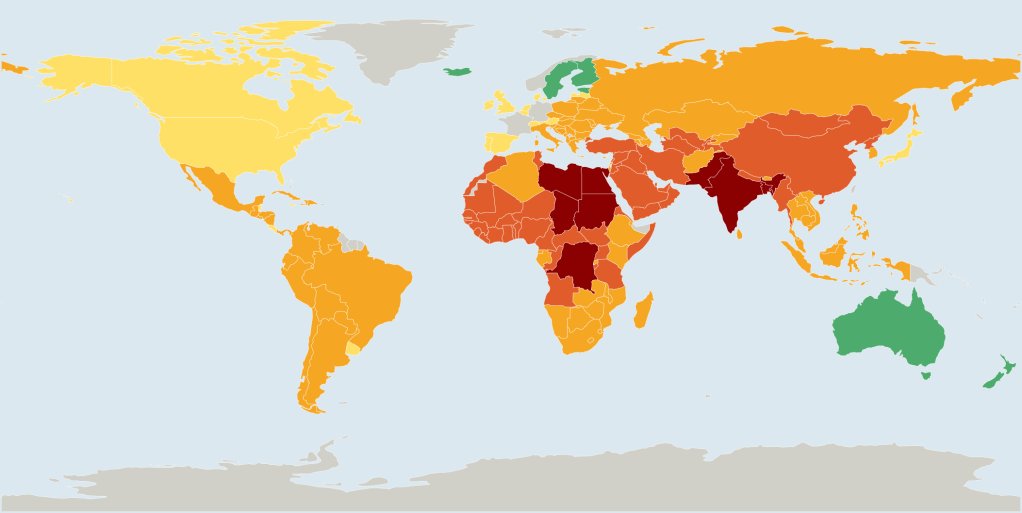

Graph made with data from IQAir 2024 World Quality Report from country data collected at over 40,000 field sites
OK SO ATMOSPHERE CRASH COURSE: Virtually 100% of the atmosphere’s bulk composition is known (chemistry class heroes remember our good old 79% nitrogen, 20% oxygen, 0.5% argon), but the trace gases emitted by both natural and human sources make a huge difference. Imagine these are like little chilis in your guacamole. If they’re a small fraction, small changes to small concentrations make a big impact. Because the atmosphere has such high energy (sunlight constantly zapping the system) and is highly oxidizing (thank you, 20% oxygen), the chemistry up there is genuinely wack. Most of it is radical chemistry – and a radical is like the chaotic younger sister to the type A ion sister. Both are “incomplete” in different ways: a radical is like a person who lost a glove while shoveling in the middle of a snowstorm, desperately searching for something to pair with. An ion is more like someone who lost their wallet – electrically off-balance, definitely not super happy but not necessarily in a screaming rush to react. Because the atmosphere runs on radical chemistry, reactions happen fast and desperately.
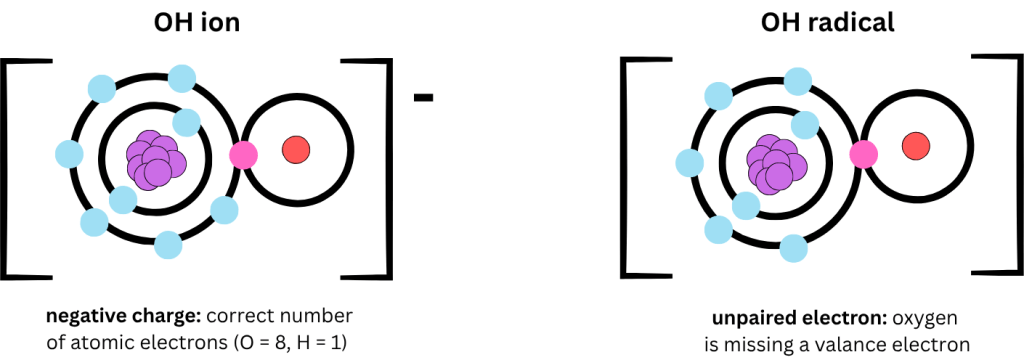
All of these reactions essentially go one of three ways: particles gain mass and deposit back to land, go on to seed a cloud, or fragment down to smaller molecules like CO and CO₂. The vast majority end up as CO₂, because most fossil fuel combustion is already so energetically complete that what comes out is already tiny and thermodynamically stable. And because CO₂ is so stable, it sticks around in the atmosphere for up to 120 years; meaning whatever we are doing now is locked in for a long time.
So what is Earth doing to protect our dumbass-ness? CLOUDS. The largest uncertainty in atmospheric chemistry is the aerosol-cloud interaction: how the tiny particles that seed clouds are affecting the climate. On a hot day, wearing dark colors (the dark ocean) makes you hotter because it absorbs more visible light and turns it into heat. Wearing white (the clouds) keeps you cool because it reflects most of the wavelengths in sunlight, aka the “albedo effect.”
Okay bear with me now, I’m going to break down what all of these increased emissions are doing to the heat on our planet *whisper* global warming *gasp*! This can be thought of in two SEPARATE cycles; the ozone cycle (yeah that ozone hole they were talking about a few decades ago) and the greenhouse effect.
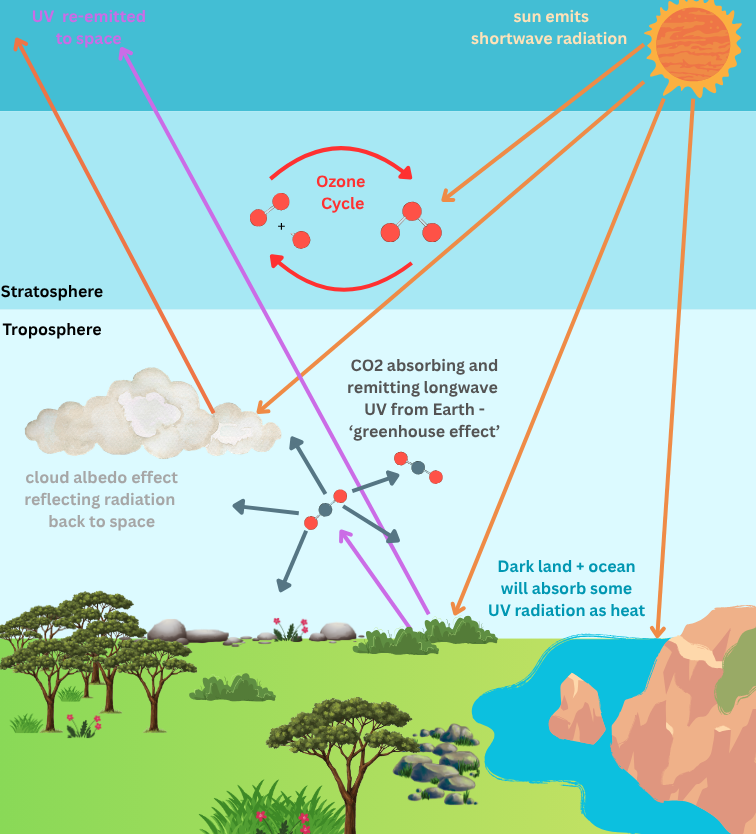
CO₂ warms the planet through the greenhouse effect: it lets the sun’s shortwave radiation pass right through on the way down, but intercepts the heat trying to escape back to space. The Earth absorbs sunlight and re-emits it as infrared, and CO₂ catches that outgoing heat and bounces some back down – like wrapping the planet in an invisible blanket. This comes down to molecular physics: CO₂ has a vibration mode that lets it absorb infrared photons, while nitrogen and oxygen (99% of the atmosphere) are symmetric molecules that just let it pass straight through, useless bouncers. A warmer atmosphere also holds more water vapor, which is itself a greenhouse gas, roughly doubling the original warming effect. And before you think “well we’ll just emit a little less” … the relationship is logarithmic, meaning the CO₂ we’ve already pumped out has done the heavy lifting, and every additional bit is kicking a planet that’s already down.
The ozone layer, sitting up in the stratosphere, works differently – intercepting UV radiation through a continuous cycle called the Chapman cycle, which breaks and reforms ozone using the sun’s own energy. Long-lived pollutants like chlorine-containing compounds can interfere with this cycle, which is part of why we don’t fly commercial planes through the stratosphere, and why all those rockets in the 1960s were so problematic (check out this study about the effect of rockets).
So back to clouds – our dumb luck insurance policy. Clouds cover nearly 60% of the Earth, reflect 20–30% of all incoming solar radiation straight back to space, and are thought to be offsetting up to a third of the warming from CO₂. A world without clouds would be (literally) cooked. But here’s the wild part: we barely understand them. The aerosol-cloud interaction is the single largest source of uncertainty in every climate model we have. We can model the orbital mechanics of planets billions of miles away with more confidence than we can predict what a cloud will do next Tuesday. Clouds can both warm and cool depending on their altitude, thickness, and composition, and small changes in global cloud cover could either accelerate warming or partially offset it… we genuinely don’t know which way it’ll tip. And you know what, as a grad student, I resonate with that.
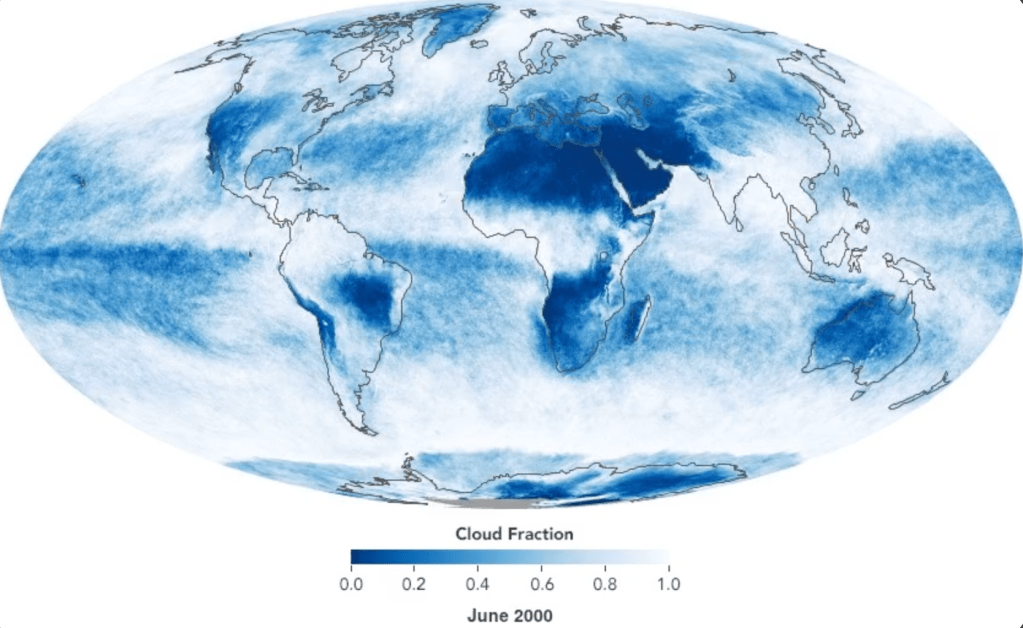
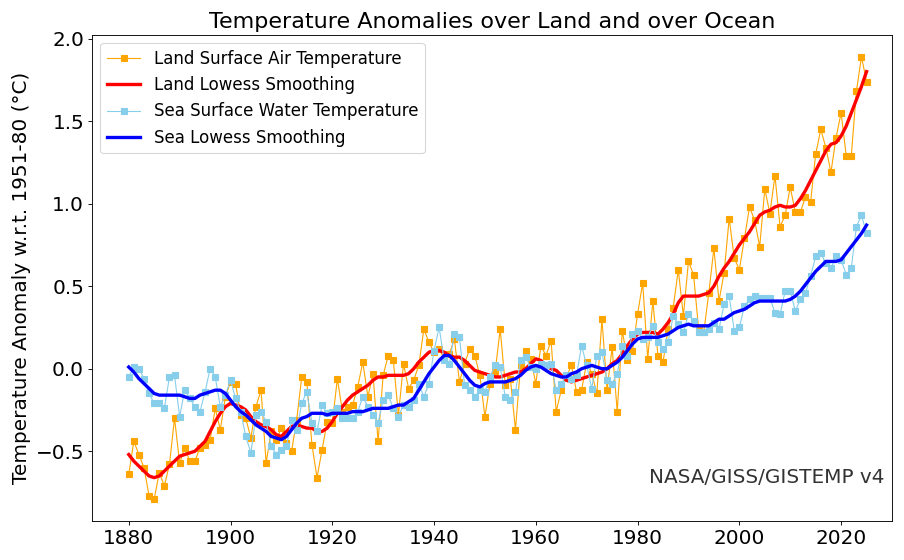
Both graphs from NASA: Cloud fraction averaged for the month of June 2000. Temperature increase over land and see from 1880-2020
So while we’re busy arguing about carbon taxes and electric cars, the atmosphere is up there running a chemistry experiment that could decide the whole ballgame, and we’re still figuring out the basic rules. Cloud and aerosol research isn’t a niche academic interest, it’s arguably the most important gap in our understanding of our own planet’s life support system.
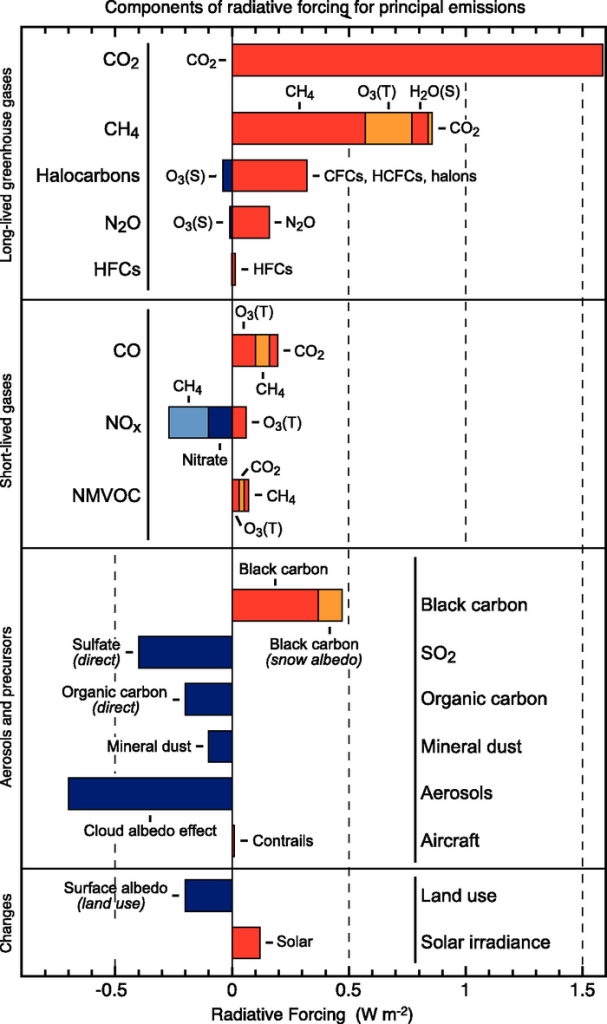
IPCC 2007 : this radiative forcing on the x-axis is essentially heating from the sun. Anything that is POSITIVE is WARMING the Earth. Anything that is NEGATIVE is COOLING the Earth. Greenhouse gases like CO2 and CH4 are really in that net positive (they are being the problem). But look at those aerosols…. they are the largest net negative we have. However, they are extremely uncertain. They could be saving us from the frying pan but who knows who, why, how.
 Earth in Plain Sight
Leave a comment