dedicated to:
my beautiful best friend teacher Saai Rung (Teacher rainbow!) and my beautiful brilliant Dr. sister Georgia ❤
My sister defended her thesis last week (Dr. G!!!) and at a beautiful dinner on Mount Washington, we experienced something absolutely sublime in this little human existence: a triple rainbow. Even as an atmospheric scientist, that feeling of divinity, of hope, the absolute blessing from the universe on such a special day can’t help but be intentional.
A rainbow is, at its core, a trick. Water droplets in the air act like tiny prisms, bending incoming sunlight and splitting it into its component wavelengths- and because physics is wonderfully rigid about this, those wavelengths always separate in the same order. Every time. Red on the outside, violet on the inside. You’re not seeing a thing in the sky so much as you’re seeing light itself, sorted.
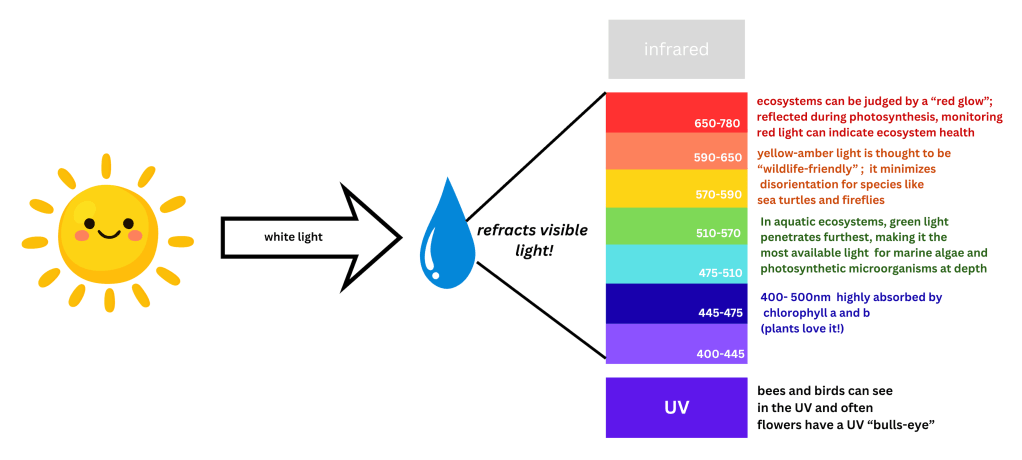
The sky dances and puts on shows for us like this all the time! Sunsets are refractions. Clouds are white because they’re reflecting light while forming, but just before a storm, the droplets clump together and let more light through, turning everything into an ominously warning shade of gray. The way light moves through the atmosphere isn’t just meteorology, it’s the entire aesthetic of being alive on this planet.
Rainbows are always a spectrum hiding inside every beam of white light, waiting for exactly the right conditions: large droplets suspended in the air in front of you (whether from imminent rain, waterfall, waves crashing), the sun at your back and needing to be less than 42 degrees above the horizon. Each raindrop acts as a tiny round sky mirror, bending the light as it enters, bouncing it off the curved interior wall, and bending it again as it exits – and because that exit angle lands right at 42 degrees, all those redirected rays concentrate into one focused beam of separated color aimed directly at your eye. The atmosphere, briefly, arranging itself into a personal light show.
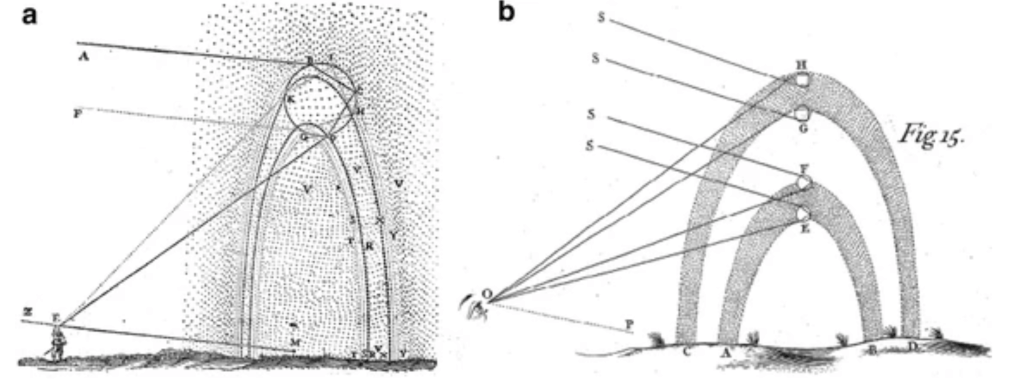
Image and caption from “A short history of the rainbow” Corradi 2016: a. René Descartes, Discours de la méthode…, p. 251. b. Newton’s rainbow (illustration from Isaac Newton’s treatise Opticks, London: S. Smith and B. Walford, 1704)
Oh and just when you thought it couldn’t get any better: double rainbows are even COOLER. When light enters a raindrop, not all of it escapes after the first internal reflection. A portion bounces around for a second pass, traveling a slightly different path inside the drop before finally escaping at a wider angle of about 50 degrees rather than the 42 degrees of the primary rainbow. That extra journey inside the droplet flips everything, so the colors in the outer rainbow run in reverse (red on the inside, violet on the outside) the sky showing you the same trick twice, backwards (look mom no hands!). This, for some reason, reminds me of Aristophanes’ speech in Plato’s Symposium about humans split in half, desperately searching down on Earth for their soulmate to feel whole again, not knowing it has a beautiful reflection somewhere lighting up the world…
Why stop at double?! Light can actually reflect three, four, even more times inside a single raindrop. Theoretically, there are tertiary and quaternary rainbows out there. In practice, each additional reflection loses energy and the resulting rainbow becomes too faint to see under normal conditions, which means somewhere above your head, invisible rainbows are stacked on top of each other like a secret the atmosphere is keeping to itself.
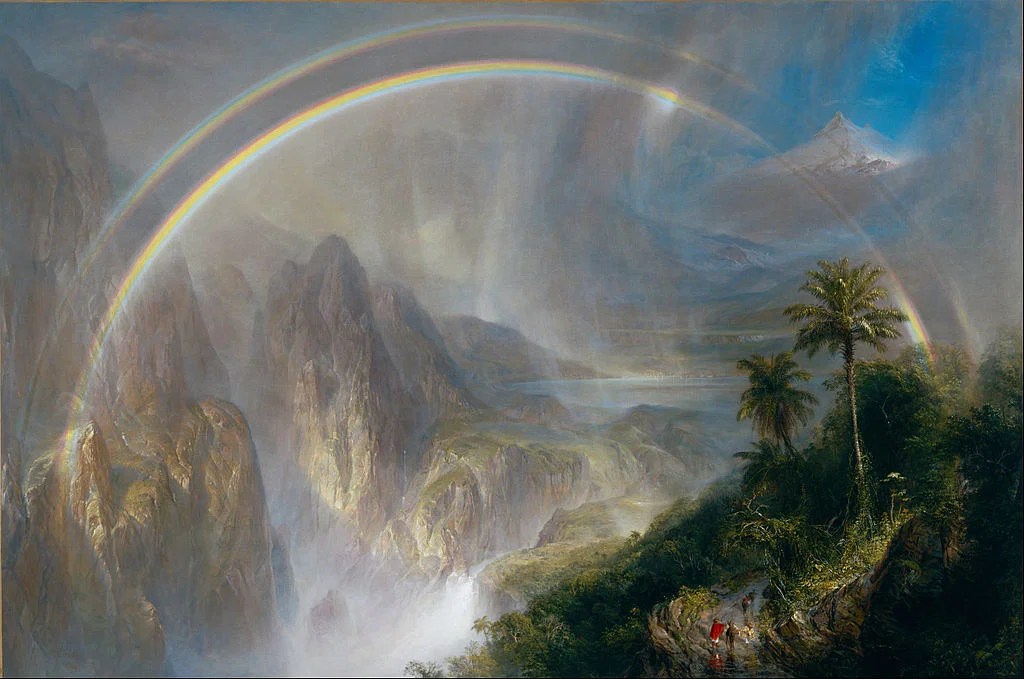
Rainy Season in the Tropics (1866) by Frederic Edwin Church
MYTHOLOGY OF RAINBOWS THROUGHOUT HUMAN HISTORY:
Humans have been trying to figure this light refraction thing out for a long time. Aristotle gave the first serious attempt at a complete description around 350 BCE, which was admirable and mostly wrong (never forget although brilliant he related women to natural slaves… *old white man grimace*…), but points for effort. Writings about light and refraction trickled in across centuries, from cultures all over the world, each one getting a little closer. It took until 1666 for Newton to finally crack it: the refractive index of light depends on its wavelength, so each color bends at a slightly different angle. The rainbow was never a ribbon painted across the sky.
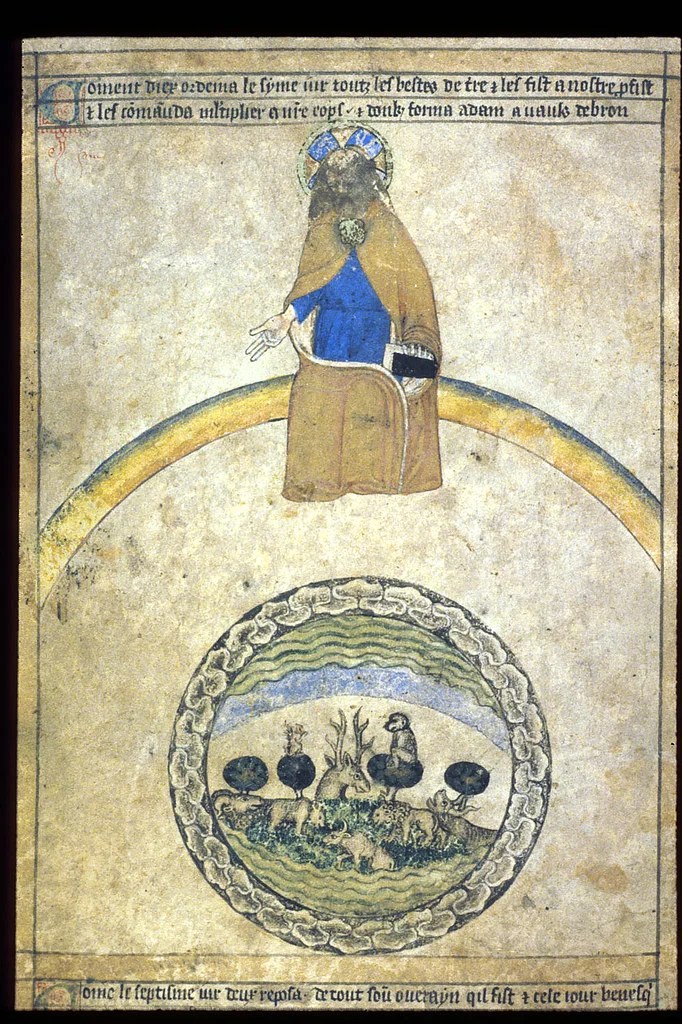
Drawing from 14th-century “Egerton Genesis Picture Book“, picturing the Fifth day of Creation
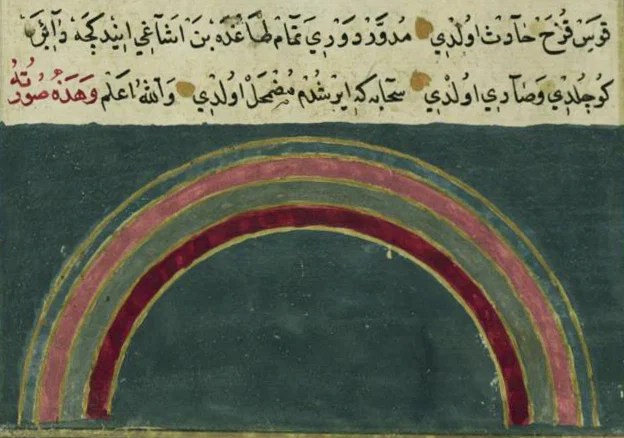
ABOVE: Ink and pigments drawing from Persian artist Zakariya ibn Muhammad Qazwini (1203-1283)
BELOW: Newton, Getty Images

In Norse mythology, the Bifröst, a rainbow bridge, connected the human world to the realm of the gods. In the Hebrew Bible, it’s a covenant, a divine promise stretched across the sky after the flood (Noah bestie did get a little universe gift after that traumatic experience). In parts of West Africa, the rainbow was a great serpent named Ayida-Weddo, encircling the earth. And in an almost suspiciously large number of cultures across Europe and Asia, the rainbow was associated with enormous, luminous, serpentine creatures that appeared in the sky. Which is to say: there is a credible scholarly argument that dragons, one of the most universal mythological creatures in human history, are at least partially descended from the rainbow (article The Origin of Dragons by Robert Blust is a fascinating read).
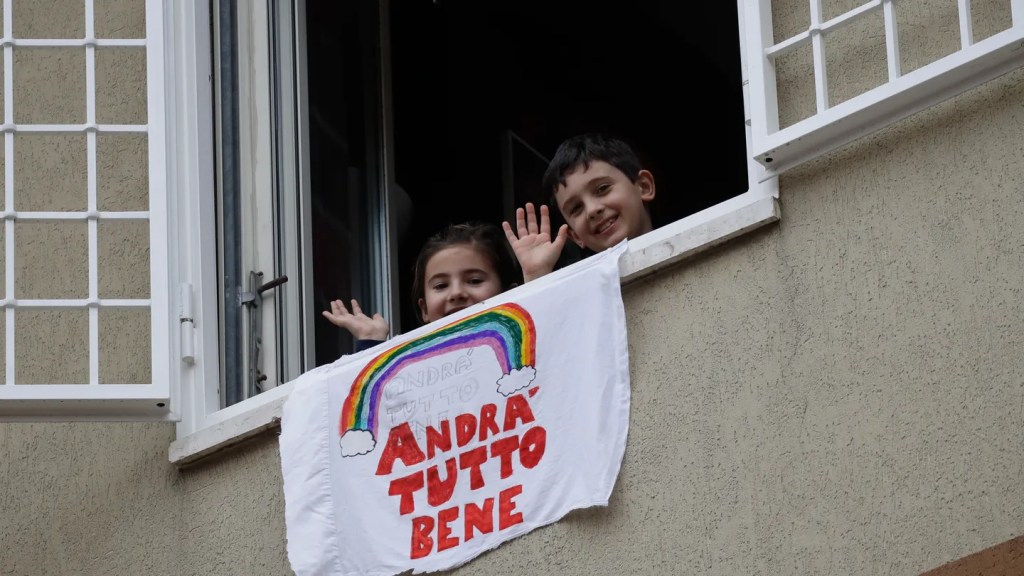
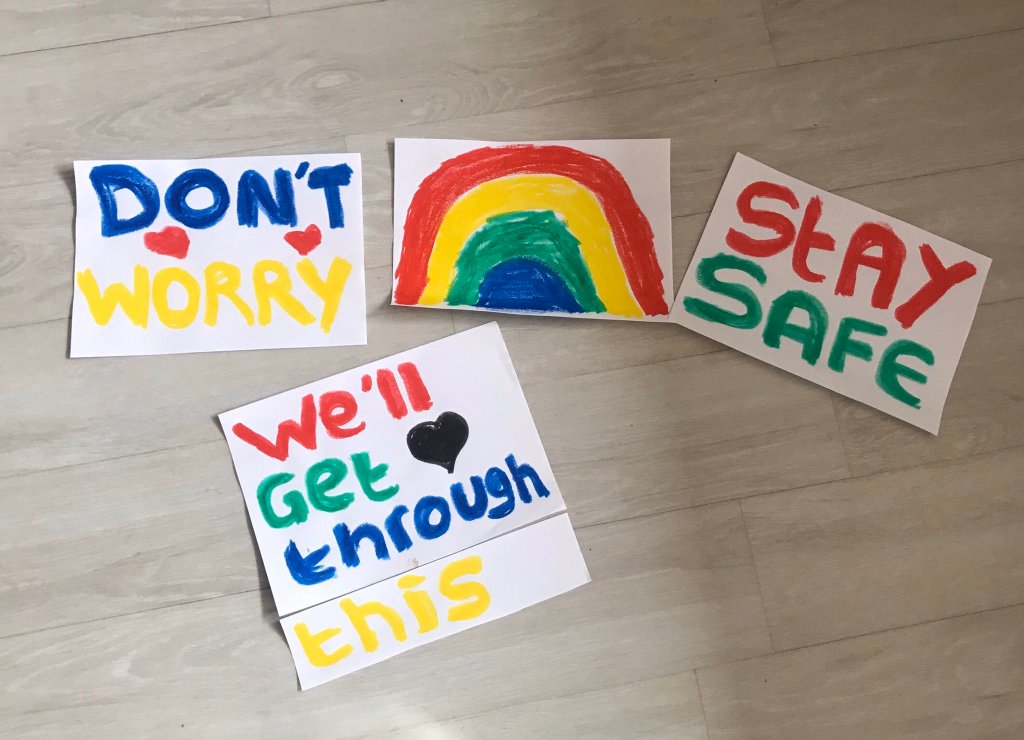
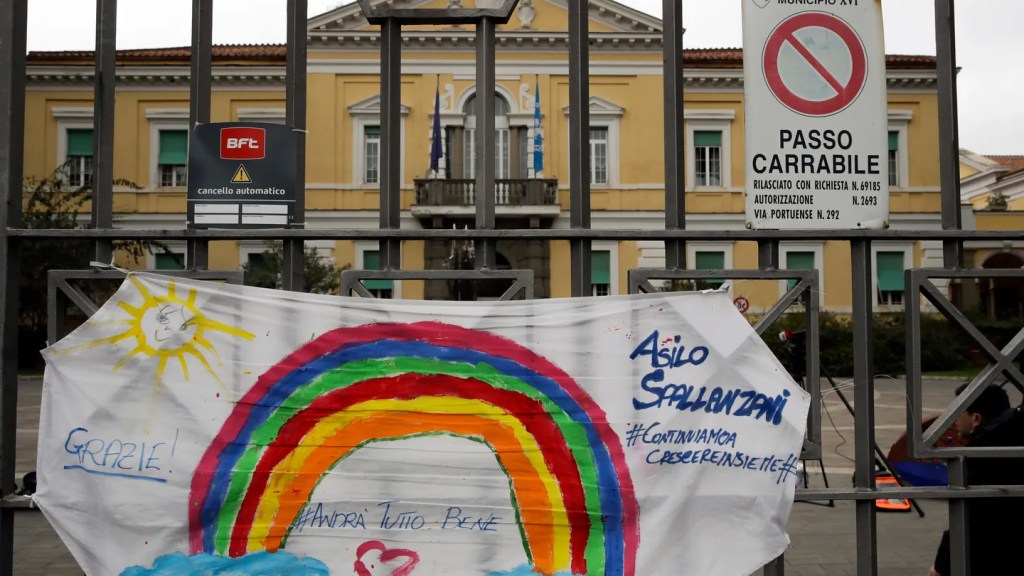
Today, rainbows are a sign of inclusion, of hope; and often symbols for movements of social change: protests in Italy anti-nuclear weapons in 1961, Gilbert Baker using it for pride LGBTQ in the 1970s, 1990s it became the symbol for South Africa reconciliation and union. Most recently, rainbows were seen as a sign of hope in the pandemic, signs hanging outside of houses as a symbol of times to come.
Although… not all of those conclusions were signs of hope as we often presume. Across more than 124 cultures worldwide, pointing at a rainbow is, or was, considered a serious taboo. The specifics vary: in some traditions it insults the spirits, in others it invites bad luck, in others it risks bringing the rainbow’s power down on you personally. Is a rainbow proof that you survived, the world newly washed and gleaming? Or a reminder that the storm will always come back?
AND ON THAT NOTE… HOW WILL RAINBOWS CHANGE WITH CHANGING CLIMATE?
In 2022, a team of researchers led by Kimberly Carlson published what is, to their knowledge, the first serious attempt to map rainbow occurrences across the entire planet, and then model what happens to that map as the climate changes. They built a global database of crowd-sourced rainbow photographs, trained a predictive model on the atmospheric conditions required for rainbows to form, and ran it against climate projections through the year 2100. The result is one of the more quietly devastating papers in recent climate literature.
Here is what they found: the average location on Earth currently experiences somewhere between 46 and 188 rainbow-days per year. By 2100, the global net picture actually looks fine – a 4 to 5% increase in rainbow-days worldwide (which is the headline that often references this article), which sounds like good news until you read the next sentence. That net gain masks an enormous redistribution. Roughly a quarter to a third of all land areas will lose rainbow-days. And those losses are not evenly distributed.
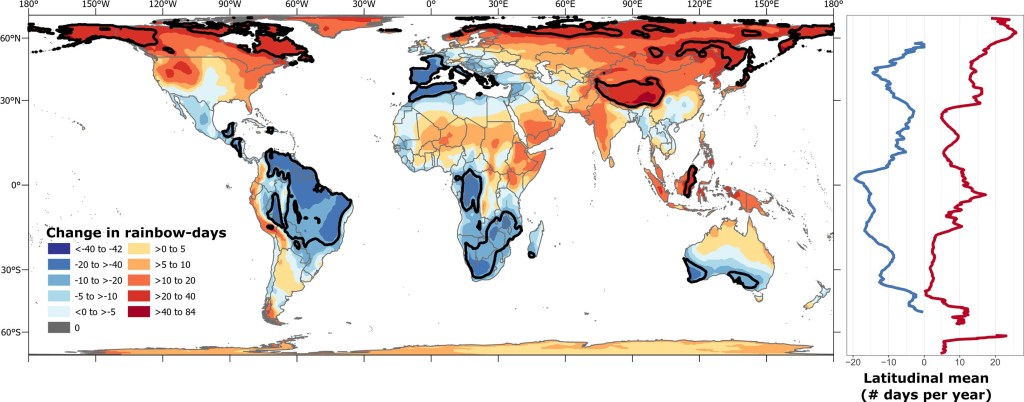
The places projected to lose the most rainbows are the Mediterranean, much of Brazil and northeast South America, southern Australia, and parts of Central and Southern Africa. The places projected to gain rainbows are Alaska, northern Norway, the Korean Peninsula, Japan, and the Tibetan Plateau. In other words: it appears that rainbows are moving to places with smaller, wealthier populations, and retreating from places that are already bearing the heaviest costs of climate change.
This is not a coincidence. Rainbows need specific conditions – liquid precipitation, sun at a low enough angle, skies clear enough to let light through. As rainfall becomes more extreme and concentrated into fewer, heavier events, as dry days multiply, as cloud patterns shift, those conditions get rearranged. The atmosphere that has been bending light into arcs for all of human history is being reorganized.
Besides the climate implications, Carlson’s team makes a point worth pondering: rainbows are what researchers call a cultural ecosystem service: a non-material benefit that nature provides to human wellbeing. They are ephemeral, place-specific, and non-substitutable. A photograph of a rainbow is not the same as a rainbow. In this increasingly screen-focused world there are some experiences that are still innately human. A rainbow somewhere else is not the same as a rainbow here, in this place, on this morning, sharing with the person next to you, after this particular storm, after this particular bad day or PhD defense. The loss of rainbows carries a weight that doesn’t show up in any economic model.
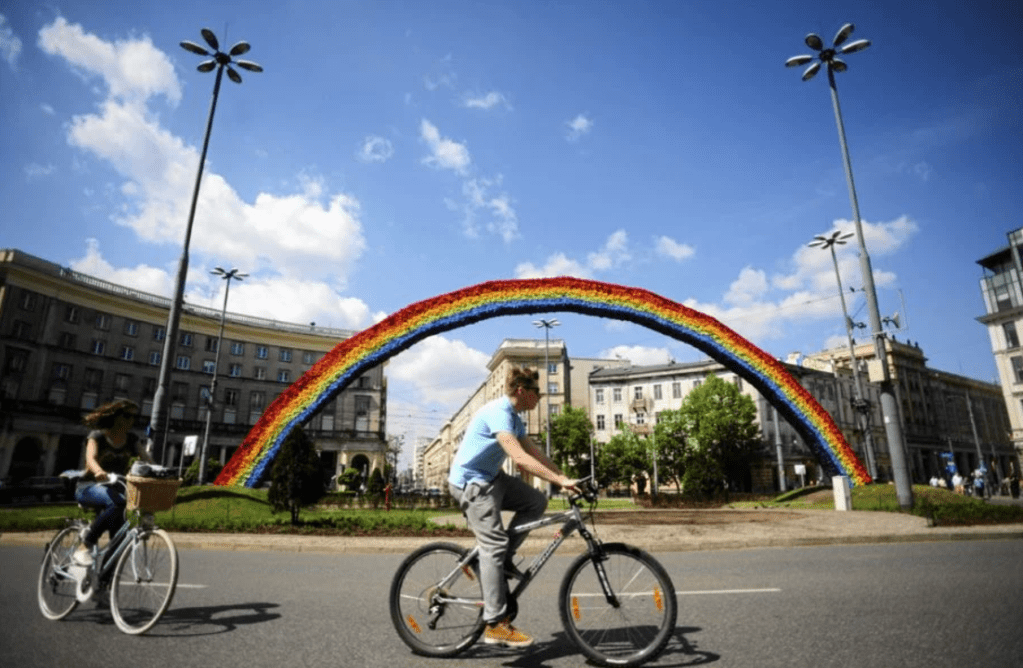
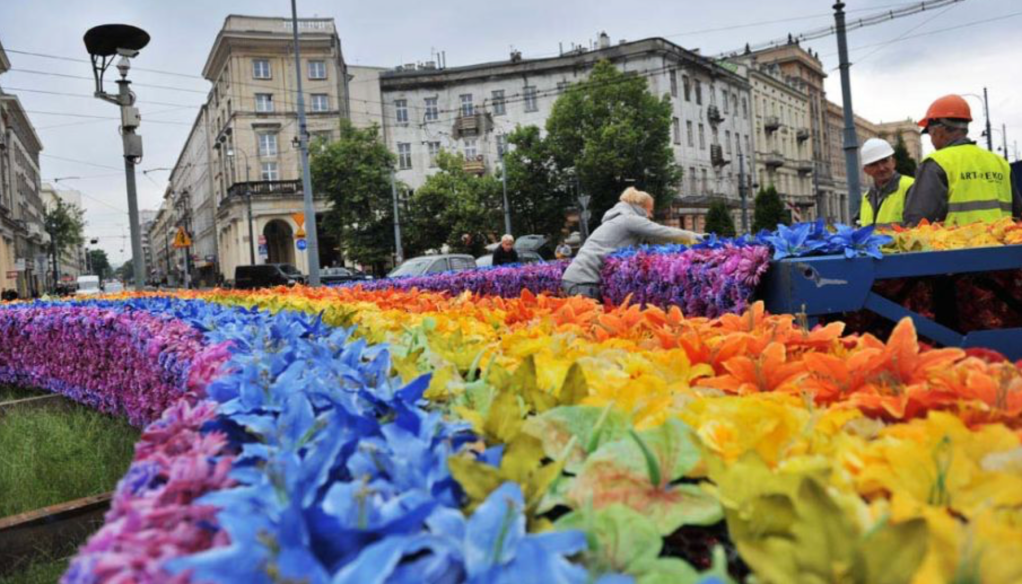
In 2012, Polish artist Julita Wójcik installed a giant rainbow woven entirely from colorful flowers in the middle of Saviour Square in Warsaw. A massive, joyful, unapologetically beautiful thing planted right in the center of the city, because sometimes that’s exactly what a city needs.
And yet, even as the map of rainbows shifts beneath our feet, we persist in looking up. We always have. The rainbow has outlasted every civilization that ever feared it, worshipped it, or built a myth around it- and it will outlast our current moment of reckoning too. What changes is the climate, and we do not to worry about it. What doesn’t change, apparently, is us: still stopping mid-stride, still grabbing the person next to us by the arm, still completely unable to act casual about a rainbow. It continues to find us, and we continue to let it mean something.
SOME READING FOR RAINBOWS IN MODERN THOUGHT: Robert Frost’s poem “Iris in the Night” is one of the quieter gifts in American poetry. Written about his deep friendship with the English poet Edward Thomas – a friendship cut short when Thomas was killed in World War I – the poem describes the two of them walking together at dusk when a moonbow, rare and luminous, slowly encircles them both. A phenomenon rare and gentle offering, just… present. As if the sky had decided to come down and connect them across the heaven and earth.
This poem carries more weight than it first appears. Iris was the Greek goddess who personified the rainbow, daughter of Thaumas, whose name means “wonder.” The rainbow in the poem isn’t decoration; it is wonder itself, arriving to hold two friends inside a single ring of light. Scholars have noted that when the rainbow lifts its ends and closes into a circle around them, it reads as a rare moment in Frost’s work of what you might call Wordsworthian sympathy; nature not as backdrop, but as participant. A third presence. Bearing witness.
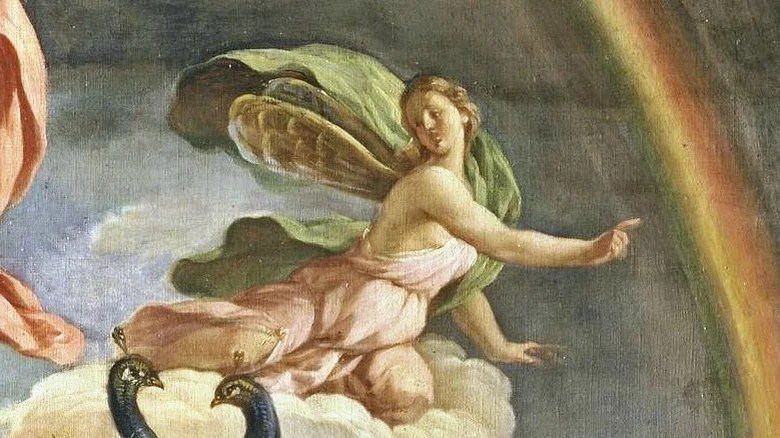
Antonio Palomino (1655 – 1726)
Carlson’s paper on climate changing rainbows cites an old piece of American maritime folklore in passing, almost as an aside: Rainbow in the morning, sailors take warning; rainbow at night, sailors’ delight. As the granddaughter of a sailor, I grew up with this, and it’s truly something that is used and believed. For centuries, rainbows were functional – they told you where the rain was, which way the weather was moving, what the day ahead held. They were information, written in light. We are now, methodically and measurably, changing the conditions under which that information appears. Cherish every moment! Love every rainbow! And the world as she changes with us.
 Earth in Plain Sight
Leave a comment