As an atmospheric science researcher, I’ve been thinking a lot lately about the “so what” of this work; how findings like mine actually translate into air quality policy, and from there into real health outcomes in real communities. In the US, we’ve made our remaining air quality gains at pennies on the dollar compared to places where dirty air is a far more acute, immediate crisis. In traditionally wealthier countries, the pipeline typically runs science → policy → practice, and, it works (as well as government environmental law can) . Plenty of lower-income countries have adopted the same policy standards on paper, which assumes a pipeline that, for them, was never built. That gap between the standard on the books and the standard on the ground is the real reason why the translation from science to practice isn’t a general copy and paste you can assume is equal across the globe.
Up to 99% of people on Earth breathe air that fails World Health Organization safety guidelines, and that polluted air cuts the average human life short by nearly two years globally (State of Global Air 2024, HEI), the second leading cause of death in the WORLD. But the burden isn’t spread evenly. Roughly 700,000 children under five die every year from air pollution ; about 2,000 a day (State of Global Air 2024, HEI).
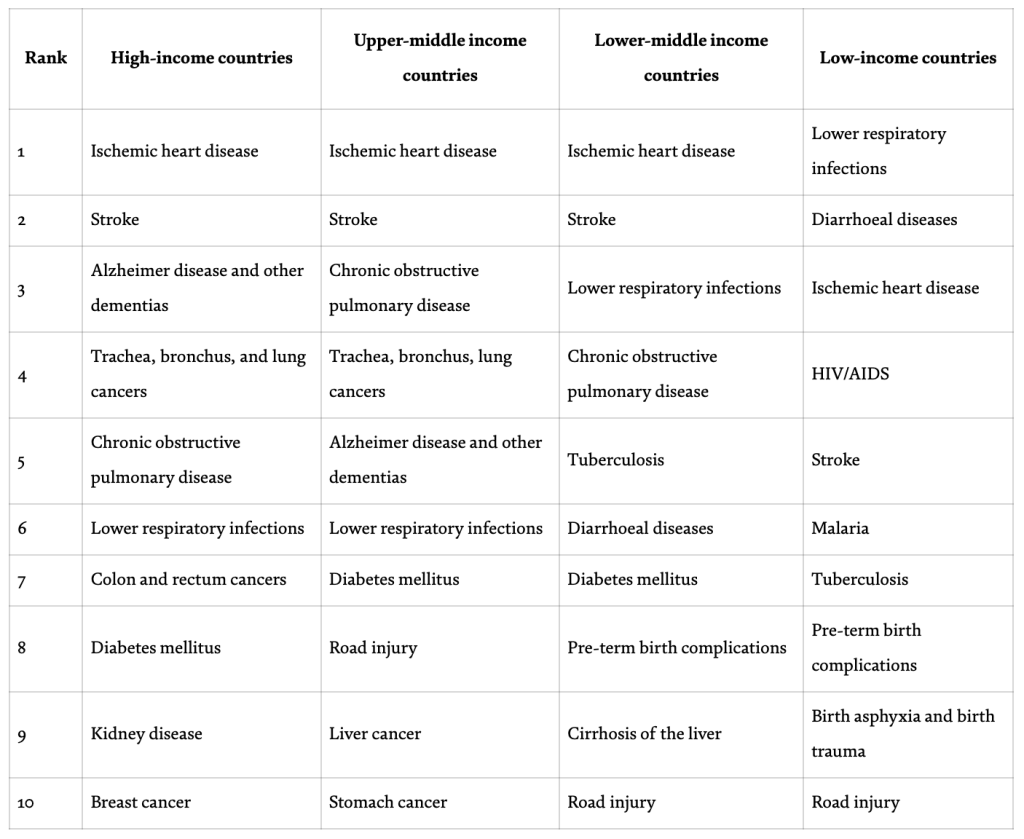
Here’s a table from Mullings et al., 2019 using WHO data. For low income countries respiratory diseases and diarrhoeal diseases are the leading causes of death. A child in sub-Saharan Africa is around 100 times more likely to die from it than a child in a wealthy country (State of Global Air 2024, HEI). ONE HUNDRED TIMES. ONE. HUNDRED. A wealthy child’s odds of getting wet are from a single raindrop; a poor child’s odds are the whole storm.
So what do we do? The usual response to statistics like these is to call for better regulation. Science to policy, policy to practice. Ban the coal. Fine the factories. Enforce the standard. But in much of the developing world, the dirtiest practices aren’t a failure of political will, they’re the only affordable option available. They are the only option for families trying to survive. These regulations could hurt a family more than it could help them. We cannot just tell a family struggling to survive what a law means in terms of numbers and money. Understanding why requires looking past policy and into the physics, chemistry, and economics of how people actually heat their homes, cook their food, and clear their land.

MONGOLIA: COAL BECAUSE THE ALTERNATIVE IS FREEZING
Shoutout my bestie Corrine who just traveled to Mongolia to research indigenous education and fell in love with the people, passing that love to me and through me. Ulaanbaatar is the coldest capital city on Earth, with winter temperatures regularly falling below −40°F. On the city’s outskirts sit the “ger districts”, informal settlements of traditional felt tents, now home to roughly 60% of the capital’s population, many of them herding families driven off the land by dzuds, the increasingly severe winter die-offs of livestock linked to climate change (Kleinman Center for Energy Policy, 2024).
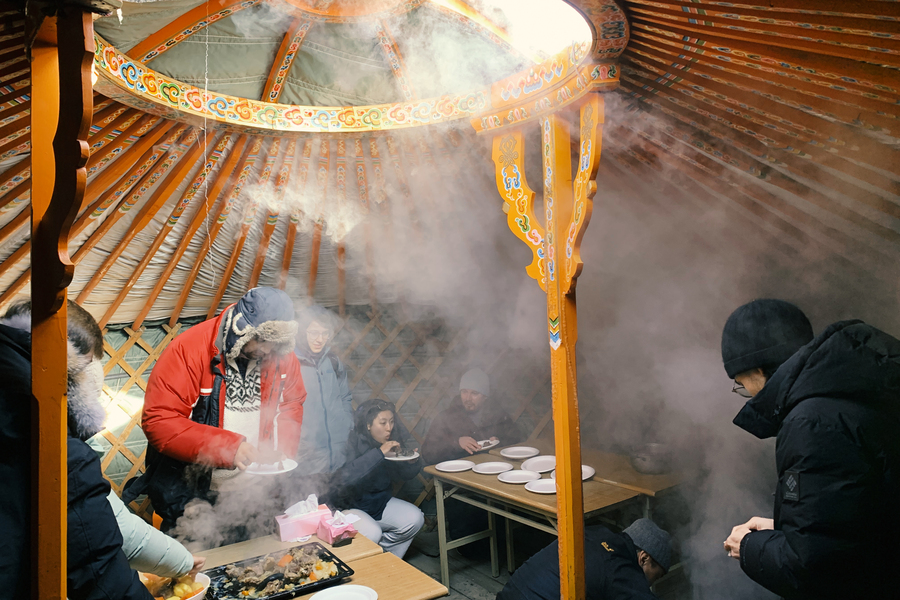
Photo: Jiyoo Jye, MIT News
To survive, more than 200,000 ger households burn upwards of 600,000 tons of coal each winter (that is three to five tons per household) producing daily PM2.5 concentrations of 104–113 μg/m³, four to five times the WHO guideline (Badarch et al., 2021).
Ulaanbaatar is one of the most polluted cities in the world: raw coal burned in small, poorly ventilated stoves undergoes incomplete combustion, releasing far more particulate matter and carbon monoxide than the same fuel burned in an industrial boiler with proper airflow and temperature control. When Ulaanbaatar banned raw coal in 2019 and mandated cleaner briquettes, the science was sound… but the economics weren’t (JPIA 2021). Briquettes cost more, and some of the poorest families responded not by going smokeless but by burning illegally logged wood or scavenged rubber instead (Kleinman Center for Energy Policy, 2024). A policy built around banning a fuel, without subsidizing the clean substitute, simply relocated the pollution.
NEPAL: BRICKS FOR A COUNTRY THAT MUST KEEP REBUILDING
Nepal runs roughly 1,600 brick kilns, most using a century-old design called the Bull’s Trench kiln, burning about a million tonnes of coal a year (World Bank, cited in Kathmandu Post, 2020). In the Kathmandu Valley, these kilns are responsible for an estimated 28% of particulate pollution and 40% of black carbon in winter (Kathmandu Post, 2020). Demand surged after the devastating 2015 earthquake left the country needing to rebuild fast and cheap, and some kilns fuel their fires with whatever is available – wood, old motor oil, tires, even trash (Beard et al., 2022).
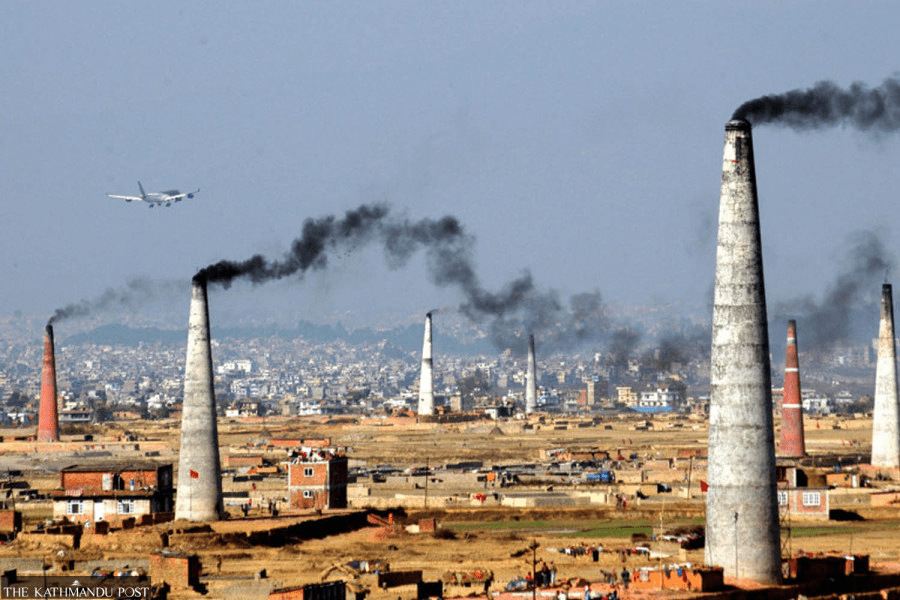
Photo: The Kathmandu Post, 2026
Here again is a case where the physics of combustion efficiency collides with economics. A 2025 economic analysis found that once you account for the health and climate costs of the pollution, cleaner brick technologies are actually cheaper for society overall, but a 50% rise in coal prices alone would push the private cost of bricks up by 11–35%, a jump individual brickmakers and buyers can’t absorb (Timilsina, Malla, and Heger 2025). Nepal’s own government estimates air pollution now costs the country more than 6% of GDP a year in lost health and productivity; several times more than it would cost to fund the transition (World Bank Blogs, 2024). The science says clean bricks pay for themselves. The cash flow says otherwise.
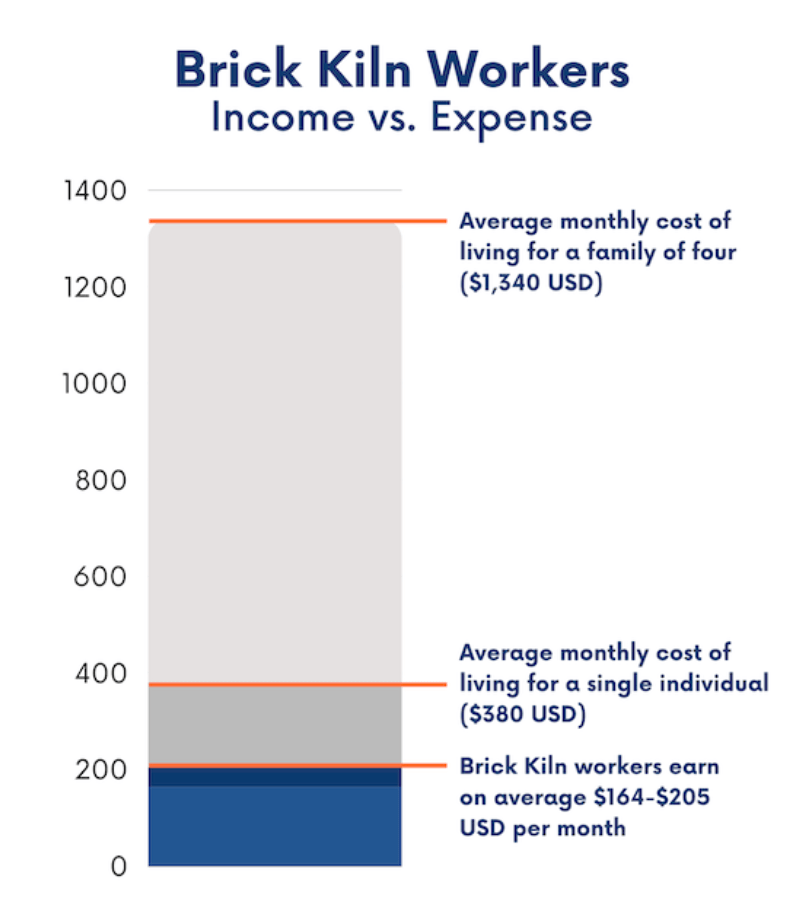
Brick Kilns in the Southeast Asia Region, plot for Pakistan data, from the Ballard Brief
INDIA: A POLICY-CREATED TIME TRAP
Punjab’s autumn smog crisis is often blamed on farmers “choosing” to burn rice stubble (The Hindu). The reality is closer to a scheduling problem than a values problem. Rules designed to conserve groundwater delayed when farmers may transplant rice, which pushed the harvest later, leaving them a shrinking window before the next wheat crop must go in the ground (Council on Energy, Environment and Water, 2024). It’s all connected! The people who are separate from the problem and the world of the problem are only redirecting it elsewhere. Mechanized harvesters, now standard, leave 1-2 feet of stubble behind versus mere inches from manual cutting, and that residue takes six weeks to decompose naturally, time farmers don’t have (Mohanty, 2020). Burning clears a field in a day.
Alternatives exist- the “Happy Seeder” attachment can plant directly through stubble, but renting one costs money, requires labor that’s often unavailable at harvest, and demands trust in unfamiliar equipment that many smallholders can’t risk (Kumar, 2024). A single well-intentioned water policy, layered onto real financial constraints, effectively engineered an air-quality crisis that now blankets Delhi every winter. We cannot have solutions that are separate from the people; theoreticals and optimals are the world of academia and not the messy true beautiful lives that are affected by these ideals.

Photo: Saving Punjab
AFRICA: THE FUEL THAT’S ALWAYS THERE
Across Africa, four in five people cook over wood, charcoal, or crop waste in open fires or leaky stoves (The Conversation, 2024), and household air pollution from this practice kills nearly 700,000 people on the continent each year (PMC, “Fuel to Pot” study, Malawi/Kenya). In Nairobi’s Kibera settlement, women who had shifted to cleaner LPG gas are switching back to charcoal as gas prices climb, as one seller put it, cooking gas is expensive and often unavailable, but “charcoal is always there” (Associated Press, 2026). Layered on top is open waste burning, which now accounts for roughly 11% of global black carbon emissions, driven largely by cities where formal trash collection simply doesn’t reach every household (Sutton, 2022).

Photo: Kisa Public Radio
Now, don’t get me wrong, I’m not hating on policy and monitoring… as written by H. J. Harrington, “Measurement is the first step that leads to control and eventually to improvement. If you can’t measure something, you can’t understand it. If you can’t understand it, you can’t control it. If you can’t control it, you can’t improve it.” In sub-Saharan Africa, only two out of 27 countries have a national pollution standard. Without a standard, there is no demand for monitoring or open pollution data to set this standard. This means disproportionate air quality mortality estimated in Africa could be vastly under (or over) estimated.
Why science, not policy alone, has to lead
Every case above shares a pattern: a cleaner technology already exists, but its cost in cold hard cash, time, or labor, falls hardest on people with the least of all three. Bans and mandates that ignore this arithmetic tend to just displace the pollution rather than eliminate it, as Mongolia’s coal ban and India’s transplant-delay rule both show. Solutions have to be found by working with the people rather than telling the people who are living it. Communities are history, they are hard work, they are unique. How can we know what is best for them without knowing them?
The more durable fixes emerging from the research are engineering and economic ones: Kenya’s BURN Manufacturing has distributed efficient clean cookstoves financed partly through carbon credits, cutting both fuel use and smoke (ACBA, 2026); Nepal is testing kiln redesigns that burn less coal for the same brick output; and Punjab researchers are pushing low-residue crop varieties that eliminate the burning question altogether (Kumar, 2024). None of these required a new law; they required making the clean option the cheap one.
That’s the real lesson buried in the data: air pollution in low-income countries isn’t a knowledge gap or a compliance problem. It’s a subsidy problem, and increasingly, an engineering one, which means the fix has to be built into the technology and the real people, not just written into the statute book.
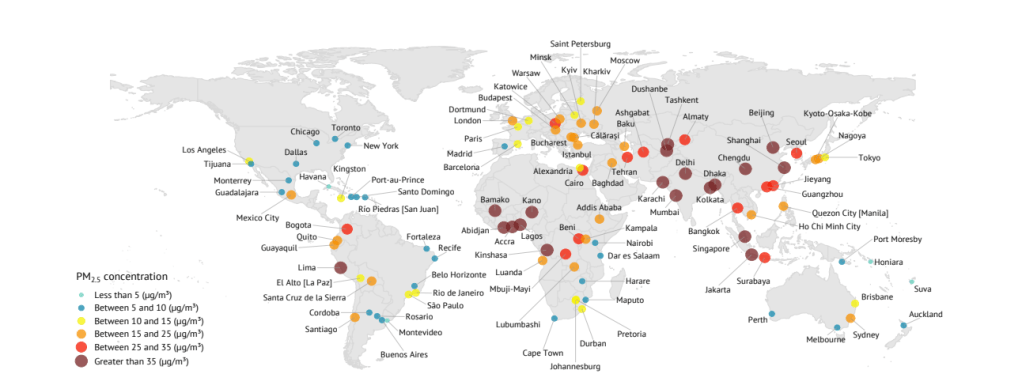
Population weighted PM 2.5 concentrations in 2019 (State of Global Air, 2022)
Bibliography
Mongolia
Ganbat, N., et al. (2025). “Insights on energy, poverty, and gender nexus in urban ger district households: A case study from Ulaanbaatar, Mongolia.” ScienceDirect. https://www.sciencedirect.com/science/article/pii/S2589791825000155
McVeigh, T. (2025). “Coal-fired heating and harsh winters are choking Mongolia’s capital city.” The Guardian, republished via EHN. https://www.ehn.org/coal-fired-heating-and-harsh-winters-are-choking-mongolia-s-capital-city
Badarch, J., Harding, J., Dickinson-Craig, E., et al. (2021). “Winter air pollution from domestic coal fired heating in Ulaanbaatar, Mongolia, is strongly associated with a major seasonal cyclic decrease in successful fecundity.” International Journal of Environmental Research and Public Health, 18(5), 2750. https://doi.org/10.3390/ijerph18052750 (via PMC: https://www.ncbi.nlm.nih.gov/pmc/articles/PMC7967474/)
Kleinman Center for Energy Policy, University of Pennsylvania. (2024). “Life with pollution vs. life in poverty: A no-win dilemma.” https://kleinmanenergy.upenn.edu/commentary/blog/life-with-pollution-vs-life-in-poverty-a-no-win-dilemma/
Green Economy Coalition. (2025). “Mongolia – the intertwined issue of air and soil pollution in Ulaanbaatar.” https://www.greeneconomycoalition.org/news-and-resources/mongolia-the-intertwined-issue-of-air-and-soil-pollution-in-ulaanbaatar
Sustainability for Students. (2022). “Air pollution in Mongolia: Ulaanbaatar is at high-risk.” https://www.sustainabilityforstudents.com/post/air-pollution-in-mongolia-ulaanbaatar-is-at-high-risk
Warburton, D., Readhead, C., et al. (n.d.). “Impact of seasonal winter air pollution on health across the lifespan in Mongolia and some putative solutions.” PMC. https://pmc.ncbi.nlm.nih.gov/articles/PMC6850795/
PMC. (n.d.). “Characteristics of indoor PM2.5 concentration in gers using coal stoves in Ulaanbaatar, Mongolia.” https://www.ncbi.nlm.nih.gov/pmc/articles/PMC6267369/
Nepal
Kathmandu Post. (2026, April 30). “The economic costs of Nepal’s air quality crisis.” Opinion. https://kathmandupost.com/columns/2026/04/30/the-economic-costs-of-nepal-s-air-quality-crisis
Kathmandu Post. (2020, May 3). “Traditional brick kilns continue to pollute air, take life and cause huge financial loss: World Bank report.” https://kathmandupost.com/national/2020/05/03/traditional-brick-kilns-continue-to-pollute-air-take-life-and-cause-huge-financial-loss-world-bank-report (also mirrored at ISET-Nepal: https://isetnepal.org.np/traditional-brick-kilns-continue-to-pollute-air-take-life-and-cause-huge-financial-loss-world-bank-report/)
Kathmandu Post. (2026, January 15). “Smog alert! Nearly 1,200 brick kilns nationwide start firing today.” https://kathmandupost.com/climate-environment/2026/01/15/smog-alert-nearly-1-200-brick-kilns-nationwide-start-firing-today
Raut, A. K., et al. (2003). “Brick kilns in Kathmandu Valley: Current status, environmental impacts and future options.” Himalayan Journal of Sciences, 1(1), 59–61. Via ResearchGate: https://www.researchgate.net/publication/240803347_Brick_Kilns_in_Kathmandu_Valley_Current_status_environmental_impacts_and_future_options
Timilsina, G. R., Malla, S., & Heger, M. P. (2025). “Economic and policy analysis of cleaner technologies for brick production in Nepal.” ScienceDirect. https://www.sciencedirect.com/science/article/abs/pii/S0301421525002484
Beard, J. D., Thygerson, S. M., Olivares, A., Tadje, J. E., Willis, S., & Johnston, J. D. (n.d.). “Gaseous air pollutants and respirable crystalline silica inside and outside homes at brick kilns in Bhaktapur, Kathmandu Valley, Nepal.” PMC. https://www.ncbi.nlm.nih.gov/pmc/articles/PMC9566599/
HERD International. (2016). “Brick kilns in Nepal – a situation report.” https://www.herd.org.np/blogs/47
World Bank Blogs. (2024). “Charting the course for clean air in Nepal.” https://blogs.worldbank.org/en/endpovertyinsouthasia/charting-course-clean-air-nepal
PMC. (n.d.). “Respiratory symptoms and illnesses related to the concentration of airborne particulate matter among brick kiln workers in Kathmandu valley, Nepal.” https://www.ncbi.nlm.nih.gov/pmc/articles/PMC5369281/
India
Wikifarmer. (2025). “Stubble burning in Punjab: Causes, effects, and sustainable solutions.” https://wikifarmer.com/library/en/article/stubble-burning-in-punjab-causes-effects-and-sustainable-solutions
Observer Research Foundation. (2025). “Stubble burning in India: Causes, consequences, and solutions.” https://www.orfonline.org/expert-speak/stubble-burning-in-india-causes-consequences-and-solutions
Mohanty, P. (2020). “Rebooting economy 40: Why Punjab farmers burn stubble?” Business Today. https://www.businesstoday.in/opinion/columns/story/indian-economy-agriculture-why-punjab-farmers-burn-stubble-crop-residue-paddy-burning-276782-2020-10-26
Current Agriculture Research Journal. (n.d.). “Stubble burning in India: Environmental concern and alternative tools.” 12(1). https://www.agriculturejournal.org/volume12number1/stubble-burning-in-india-environmental-concern-and-alternative-tools/
(2024). “Farmer perspectives on crop residue burning and sociotechnical transition in Punjab, India.” ScienceDirect. https://www.sciencedirect.com/science/article/pii/S0743016724001918
Kumar, A. (2024). “Why stubble burning continues in Punjab — perspectives from the ground.” Council on Energy, Environment and Water (CEEW). https://www.ceew.in/blogs/why-punjab-farmers-burn-paddy-stubble-and-steps-to-curb-crop-burning
CEEW. (2024). “Why do Indian farmers burn field crops & stubble in Punjab?” https://www.ceew.in/blogs/punjab-farmers-explain-why-they-burn-crop-stubble
Drishti IAS. (n.d.). “Addressing India’s stubble burning issue.” https://www.drishtiias.com/daily-updates/daily-news-analysis/addressing-india-s-stubble-burning-issue
Africa
The Conversation. (2024). “Four out of five people in Africa use wood for cooking: A transition to clean fuels would cut emissions and save lives, a model for Nigeria shows.” https://theconversation.com/four-out-of-five-people-in-africa-use-wood-for-cooking-a-transition-to-clean-fuels-would-cut-emissions-and-save-lives-a-model-for-nigeria-shows-241456
Earth.Org. (2020). “Air pollution is starting to choke Africa.” https://earth.org/air-pollution-is-starting-to-choke-africa/
AfriPoLi. (2026). “What Africa’s waste crisis reveals about power, politics and people.” https://afripoli.org/what-africas-waste-crisis-reveals-about-power-politics-and-people
Climate & Clean Air Coalition. (n.d.). “Integrated assessment of air pollution and climate change for sustainable development in Africa.” https://www.ccacoalition.org/content/integrated-assessment-air-pollution-and-climate-change-sustainable-development-africa
Sutton, J. (2022). “Open burning of waste in Africa: Challenges and opportunities.” Royal Academy of Engineering / Engineering X. https://raeng.org.uk/news/open-burning-of-waste-in-africa-challenges-and-opportunities/
Wikipedia. (n.d.). “Environmental issues in Africa.” https://en.wikipedia.org/wiki/Environmental_issues_in_Africa
Associated Press, via KSAT. (2026, April 27). “Energy shock ripples through kitchens, forests and conservation in Africa and South Asia.” https://www.ksat.com/business/2026/04/27/energy-shock-ripples-through-kitchens-forests-and-conservation-in-africa-and-south-asia/
African Circular Business Alliance (ACBA). (2026, April 1). “West Africa throws away tens of billions of dollars every year. It calls this waste management.” https://acba.africa/west-africa-throws-away-tens-of-billions-of-dollars-every-year-it-calls-this-waste-management/
PMC. (n.d.). “Exploring the use of solid fuels for cooking and household air pollution in informal settlements through photovoice: The Fuel to Pot study in Ndirande (Malawi) and Mukuru (Kenya).” https://www.ncbi.nlm.nih.gov/pmc/articles/PMC11671005/
PMC. (n.d.). “Multinational modelling of PM2.5 and CO exposures from household air pollution in peri-urban Cameroon, Ghana and Kenya.” https://www.ncbi.nlm.nih.gov/pmc/articles/PMC11865494/


Leave a comment